
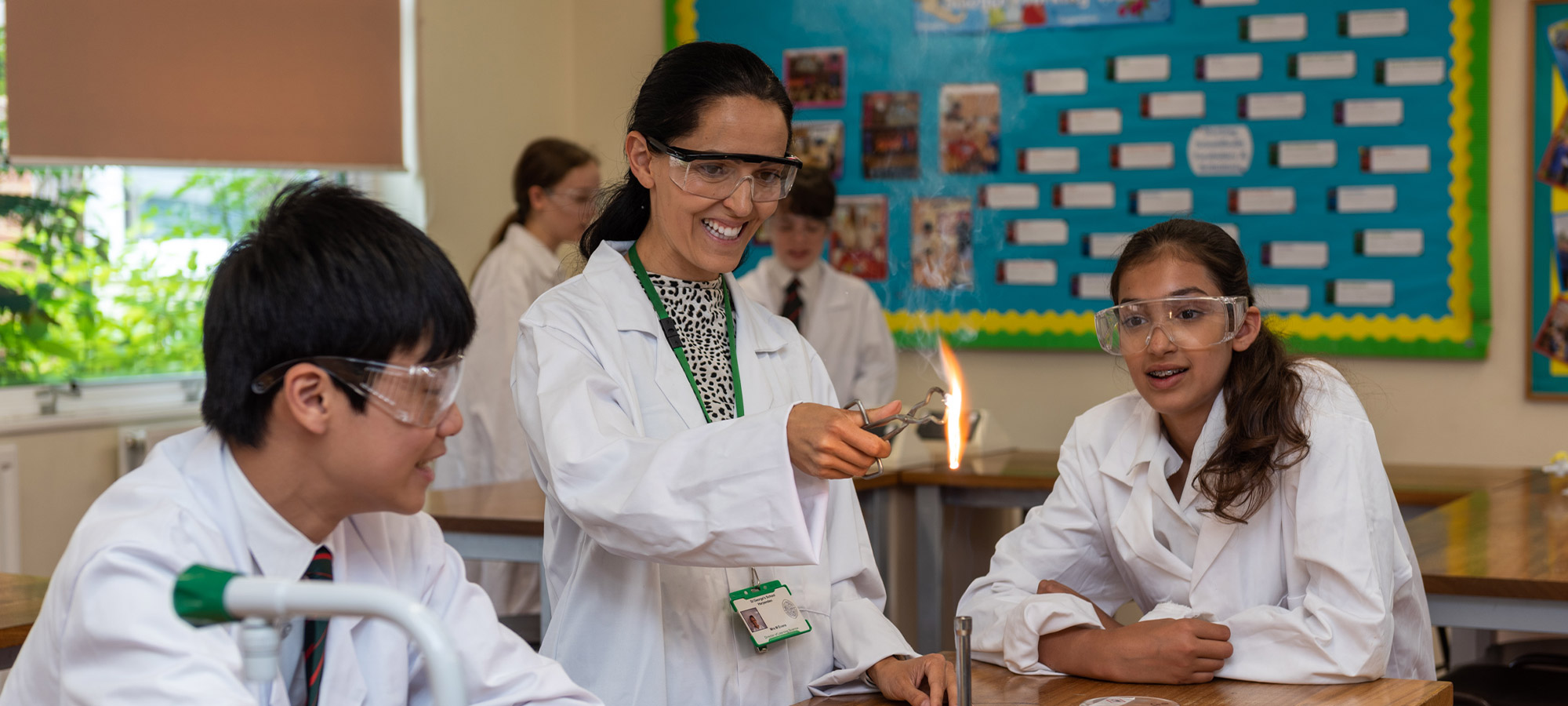
The science team encourages a curious, creative and inquisitive nature in our students.
In science lessons students get the opportunity to problem-solve, develop experimental skills, understand and explain scientific concepts, build arguments and evaluate their own understanding. The learning the students experience leads to a greater appreciation of science and its impact both on the individual and society.
The KS3 curriculum is designed to encourage students to apply and extend the new knowledge that they learn so that they are able to apply this knowledge effectively to contextualised situations. Development of key scientific vocabulary, mathematical skills and practical skills takes place, which supports the students across the whole school curriculum.
In Year 7, pupils are taught in their mixed-ability form groups. In Year 8 pupils are placed in broad bands each with high, intermediate and lower levels. This grouping is determined by their performance in Year 7 end of topic tests as well as their end of year exam. In Year 9, pupils are re-set in a similar way at the start of the year and stay with their group for all three sciences.
Continuous assessment of practical and associated skills is an important feature of our course, in which pupils are given advance warning of the criteria they must satisfy to reach various levels. Continuous assessment and feedback for improvement ensures we are able to accurately determine the tier of exams for which they are entered for GCSE.
Students are formally assessed completely and formatively during and after every topic, providing a detailed understanding of an individual’s and cohort’s strengths and areas for improvement and progress. At the end of Years 7 and 8 pupils sit an exam which mirrors the style of the Key Stage 3 tests. In year 9, the end-of-year exam contains a mixture of practical questions and multiple-choice questions to test pupils’ knowledge of the course.
Prep is typically set once a week and is designed to consolidate learning that has taken place in the lesson. Each topic taught contains assessed homework which provides the children with feedback on what they did well and how to progress to the next level.





Additional Opportunities
- Whipsnade zoo trip in year 7
- Postcard competition in year 7 on adaptations
- STEM club for KS3
- GCSE drop in sessions one lunch time per week
- Olympiads for A level biology, Chemistry and Physics
- DNA analysis using equipment loaned from Amgen multinational biopharmaceutical company. Years 11 to 13.
- ‘A level Chemistry Live’ trip for Y13 pupils
- ‘KS3 Science Live’ trip for y9 pupils going on to study separate sciences
Key teaching websites used: